
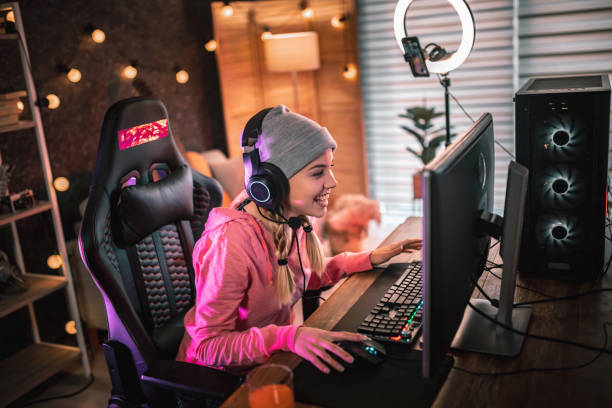
Do you remember being able to play video games as an isolated activity, sitting in a dark room? Well, that world is long gone. Gaming is no longer about the pixels to the screen; today it is a massively social, public phenomenon. It is where your friends spend their time, where the news is exposed, and, above all else, where things go viral.
The immense social media impact is being felt when a game pops into the mainstream consciousness, appearing in the niche forums to the leading stages of TikTok, YouTube, and X (formerly Twitter). It is a kind of power that can make a small indie game popular all over the world in one night. Yet how does this digital lightning strike actually occur, and what does it imply to the gigantic, $196 billion industry?
The Unstoppable Loop: Screen to Share
Social media has not only transformed gaming, but it has become the nervous system of the current gaming culture. When somebody yanks off an epic, impossible maneuver, or an NPC (Non-Playable Character) sticks, what is the very first thing they do? They rub it, put a trending sound, and press share.
This real-time sharing forms an unending cycle. These short and snappy videos are the staple of such short-form video platforms as TikTok and YouTube Shorts. It is the ideal platform for a game to instanavigate, which means it serves as the online equivalent of a quick, mass glance at content that rapidly circulates in a user’s feed.
Take the numbers into consideration: Gamers are not getting bored; they are playing. By 2023, the video game industry has brought in more than 196 billion in revenue, compared to streaming and box-office revenue combined. Most importantly, this is centered on the younger players. Almost 2–18-year-olds consider themselves gamers, and a large percentage of them consider gaming sites such as Roblox or Fortnite to be their main social network, as older generations perceive Facebook. They socialize, shop, and watch videos within the game environment, blending play and social interaction seamlessly. This isn’t just a hobby; it’s a new type of digital living.
Why Do Other Games Take the Fire?
Why does one game clip become a viral sensation on an international scale and thousands of others simply disappear? The factors contributing to a viral sensation often include a mix of elements:
- Relatability: The clip resonates with a shared emotion, such as frustration, triumph, or laughter.
- Novelty: It represents a feature or a mechanic that people have never witnessed.
- Creator Power: A prominent influencer or streamer promotes the game and drives it to their millions of loyal fans.
This organic word of mouth effectively promotes itself. When a single, genuine, 30-second video will reach the right audience with better speed and in an efficient manner, why spend millions on the conventional advertisements?
Case Study: The Silent Colossus in the Room.
As an example of the pure power of the viral effect, we could consider the fascinating case of the “social deduction” game, Among Us.
The game was initially a quiet and modest release in 2018. Streamers began playing the game in the summer of 2020 on sites like Twitch and YouTube. Not only small, but huge content The creators who discovered the fundamental aspect of the game: liars and detectives arguing in a chaotic room, which serves as a source of comedic and dramatic content.
The streams were transformed into clips; the clips were transformed into memes, and the memes burst out on all social platforms. In a moment everybody was talking about “Sus,” and Imposter, and Venting. The downloads of the game increased enormously as it went from being a comparatively unknown game to one of the most popular games worldwide.
One research article by R. W. Smith et al. may indicate that the success of Among Us was not merely a chance; instead, a simple and socially oriented mechanic combined with the ability of the platform to create user-generated content (UGC). The game did not tell a story; instead, it offered a platform for players to create their own narratives, which aligns perfectly with what viral social media aims to achieve. The moment-to-moment gameplay was an indefinitely remixable content.
The Hidden Hand: Artificial Intelligence in the Viral Machine
A game that is going viral may seem like it is a completely organic process, yet, in the background, a strong technology is now in the game: artificial intelligence (AI).
There are two ways in which Artificial Intelligence is reshaping the gaming ecosystem, having a direct influence on virality:
AI in Content Creation: Generative AI is currently utilized to generate hyper-realistic landscapes or dynamically generated speech of NPCs, which might result in unforeseen, amusing, or weird glitches and scenes—the ideal viral content. No Man’s Sky and Microsoft Flight Simulator are not the games where huge environments are generated with the help of AI-based procedural generation. The AI establishes the sandbox, and the players discover the bizarre, sharable experiences in it.
AI in Distribution and Curation: This may be the more sinister aspect. TikTok, Instagram, and YouTube are the same apps whose algorithms are based on machine learning and determine what content is viewed. They monitor the user behavior and the instanavigation cues, such as back tap on an Instagram Story (a signal that a person watched the content again) or watching the complete video all the way through to know what is really interesting. AI is constantly trying to find patterns, and when it finds a clip that can lead to significant engagement spikes, it is a digital megaphone, which will push that content to millions of other feeds. In effect, the AI identifies the viral potential and enhances it.
It works like a feedback loop: A fun game moment is recorded, AI algorithms increase the visibility due to high levels of user interaction, and the high visibility creates more content creators, which results in more players.
The Other Side: A Little Bit Too Much Too Fast
While social media can serve as an effective launchpad, it also acts as a harsh spotlight. When a game becomes viral the level of scrutiny and demand on a game is usually unmatched. There is an abrupt need to serve millions of new players, crashes of servers, bug reports, and an intense desire to see new content immediately and abruptly.
The viral wave has the power to crash the game should it not be ready. The same society that rejoiced during its ascendancy can easily become unfriendly in case of a failure to fulfill its commitments. It is a two-sided sword; enormous success leaves enormous pressure.
The point is that now gaming and social media do not exist as two worlds. They’ve fused. In the gaming industry, it is common knowledge that a great launch is no longer defined only by the scores of critics but also by its shareability score. The greatest creators of the games also do not simply construct games; they are creating content farms and social centers that are made to feed the viral machine. It appears the future of gaming success will be the possibility that it can be shared with ease, immediately and across the board.
Gaming and Social Media Statistics
Global Gaming Market Value: It is estimated that it will be approximately 187.7 billion in 2024 and is expected to continue to grow despite stabilizing after the pandemic.
Player Engagement: Participants of immersive games who perform non-gameplay activities (such as socializing and content creation) spend approximately five times the amount of time compared to participants who simply play.