
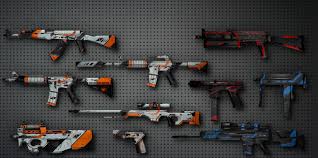
It all began when Valve dropped the CS:GO Arms Deal update in 2013. Before that, CS was only focused on the gameplay, and all of the guns had the same old gray appearance. However, Valve chose to try something new after noticing how large skins were in other games. Weapon finishes were included as strictly aesthetic additions; they did not affect damage or attributes, just appearance. They wanted a way to distinguish between “meh” and “holy” skins to make it intriguing. Rarity levels were introduced to address this.
What Is CS2 (CS:GO) Skin Rarity?
Each skin’s color indicates the CS2 (CS:GO) skin rarity tier it belongs to. The free drop skins you will receive just by playing are Consumer Grade (gray) and Industrial Grade (light blue), which sit at the bottom. They are widely available, have relatively little value, and are mostly used as filler for trade-ups. Mil-Spec is a step above that (blue). These are the most affordable case skins, and they’re still widely used, but they’re where real design and value first appear.
It then ascends into Classified (pink) and Restricted (purple). The majority of “budget bangers”—sturdy, reasonably priced, and attractive rifles, pistols, and AWPs—live on purple skins. Pink is far less common; you can sense it when you take a Classified out of a case. Depending on their condition, these designs can have actual price tags and are frequently chosen as fan favorites.
The Covert (red) layer is above that. The flagship skins, which are AKs, M4s, and AWPs that characterize collections, reside here. Consider M4 Howl (which is really much rarer because it was forbidden from dropping), AK Fire Serpent, or AWP Asiimov. Since the odds are slim and prices might rise based on excitement, receiving a red draw from a case is already exhilarating.
The true star, however, is gloves and knives. These are unique “gold” items with the rarest drop probability of all; therefore, they don’t fit into the standard rarity system. When opening a case, we’re talking lottery-ticket chances less than 1% for a knife, and much less for certain finishes like rubies or sapphires.
And within all of this, there are extra layers of rarity: finish patterns and floats. A skin’s wear level (Factory New, Minimal Wear, Field-Tested, Well-Worn, Battle-Scarred) massively changes its price. Then you’ve got special patterns, like Case Hardened “blue gems,” where the unique random texture makes the skin one-of-a-kind. Those fetch insane prices, sometimes six figures.
Who Decides Rarity?
Skins created by community artists or Valve’s own team are included in every new case or collection that is released, and Valve chooses which tier each skin belongs in. They employ rarity as a balancing mechanism, so it’s not random. They will designate a skin as Classified (pink) or Covert (red) if it is very detailed, ostentatious, or obviously has “flagship” potential. In the meantime, to increase the case probabilities, basic or filler patterns are inserted into blue or purple. Naturally, they then offer gloves or knives as the gold-tier prize.
First, it gives the game a layer of excitement and advancement. The rarity method makes opening a case seem like a lottery.
Secondly, it produced a whole ecology of marketplaces. High-tier skins gained real-world worth because Valve limited their supply, making them rare. People started trading skins like stocks and even selling them for thousands of dollars as a result.
Third, Valve discovered the psychology of rarity. People enjoy flexing, collecting, and the excitement that comes with owning something uncommon.
How CS2 (CS:GO) Rarity Influences the Market?
Rarity is literally the engine that drives the CS2 skin market; without it, skins would just be cosmetic fluff with no real value.
Due to the weighted chances in each case, most people who open them wind up getting blue skins (Mil-Spec). Since they are all around us, their worth is nothing. Due to their abundance, most blues may be purchased for a few cents. Because of their rarity, purples (restricted) are somewhat more valuable but still rather affordable. The supply drastically reduces until you hit pink (Classified) and red (Covert); fewer individuals open them, making them less common. Because of this, even a red skin with a poor appearance might cost a lot of money. Then there’s the gold tier, which includes gloves and knives, with drop probabilities so ridiculously low that supply never keeps up with demand. Because of this, even if a knife has an “ugly” design, its floor price never actually drops.
Additionally, CS2(CS:GO) rarity encourages investment and speculation. Everyone jumps to open a new case as soon as it drops, but its supply is fixed as soon as Valve removes it from the present drop pool. The rarest skins within, such as the reds, golds, and the highly sought-after purples, are now gradually becoming more expensive. The market is aware that they will become much more scarce in the future.
Conclusion
The economy as a whole is driven by this structure. Skins would only be used as cosmetics if they weren’t rare. They were transformed into a full-fledged commerce, culture, and prestige.