
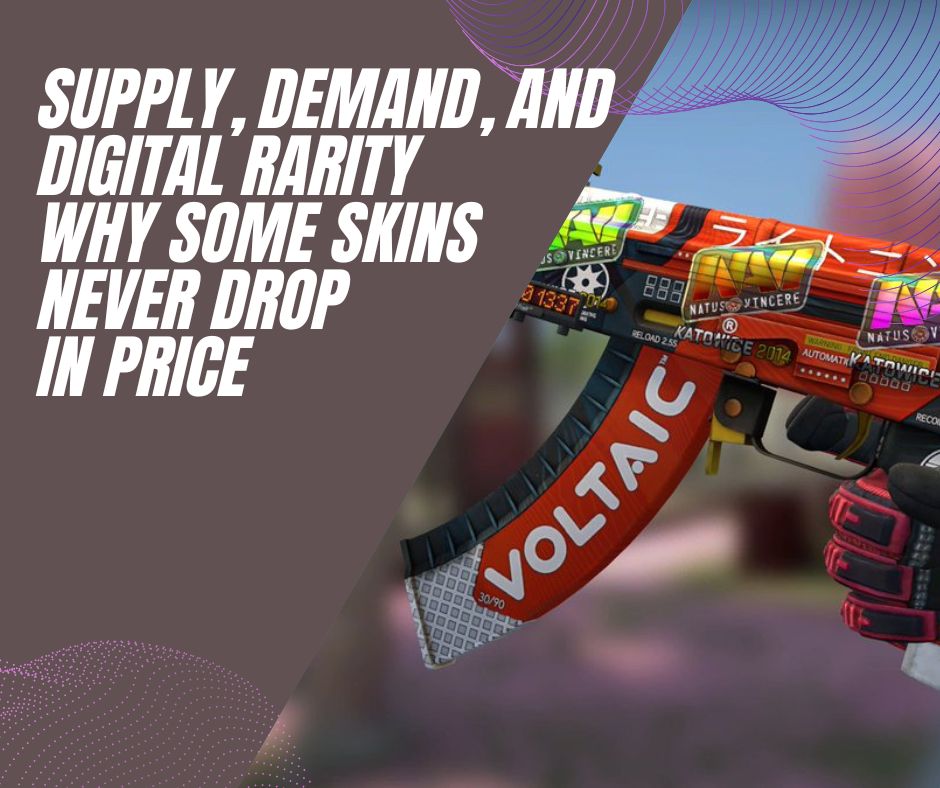
It’s hard to imagine CS2 without skins — they evoke emotions in players, allow them to express their playstyle and taste, help them find new friends, and have essentially created a marketplace that operates under the same rules as a traditional market. Players buy, sell, and trade skins. Some cost a few cents, while others can cost several thousand dollars. The price of some skins is quite volatile, while others can remain stable for years on end. Why does this happen? This article explains.
The Skin Market and the Real Economy
CS2 skins are digital items with real-world value that can be sold, bought, or traded. Skins don’t provide players with any combat advantages, but they do allow them to customize their weapons. Over the course of their existence, skins have become something of a collectible, sometimes quite valuable, for players.
The prices of CS2 items are largely determined by rarity, design appeal, and player base. If a skin has a striking design and high rarity, it’s easy to assume it will generate interest and desire among players. This is how skin prices are determined. The fewer offers for a particular skin on the market and the higher the demand, the higher its price.
Starting price of skins
When a new case is released, its contents are available to everyone. Players open the new cases en masse and can put the resulting skins up for sale. During this period, supply exceeds demand, meaning the price of the skin is quite low.
However, after a certain period of time, when the case is no longer actively dropping and player interest in the skins contained within remains, the price of the skins may increase due to increased demand. For example, this happened with the popular AWP | Asiimov skin. It was released in February 2014, and at that time, the skin price was low compared to its current value. Furthermore, the initial price of a skin is also determined by its float value, StatTrak, and the presence of a pattern.
Skin Rarity and Its Value
Each case contains skins of varying rarities. Covert skins are the fewest in a case, and these are the most valuable skins. The chance of receiving a Covert skin when opening a case is 0.64%. This means the probability is very low. If a particular case is removed from the active pool, it is essentially impossible to obtain such skins. Among the skins considered relatively inaccessible and limited are those like Karambit | Case Hardened Blue Gem or AWP | Dragon Lore. The price of such skins increases significantly and remains stable for a long time.
Skin rarity is not just a matter of statistics. For players, skin rarity is also a characteristic that determines the uniqueness of the skin and the status associated with owning it.
Steady Demand for Skins
Interestingly, gamers’ interest in CS:GO, and subsequently CS2, hasn’t waned. This means that the demand for skins with interesting designs and investment potential is stable. New shooter players want the same things as experienced players: beautiful, iconic skins that reflect their status. Some skins maintain a consistently high price for many years, and players who joined the game, for example, during the CS:GO era, are well aware of this. These are typically iconic skins with recognizable designs that are popular among pro players. These can also be rare skins. Owners of rare skins are generally reluctant to sell them. Their value can slowly but steadily increase.
Declining Skin Supply
The number of CS2 skins in circulation may indeed decrease over time. There are several reasons for this. First, it’s worth noting that many player accounts may be banned or become inactive. This means their skins disappear from the market. Furthermore, the active case pool is constantly updated — new cases are added and older ones are removed. Thus, older skins become more valuable every year.
To monitor skin price dynamics, players and traders use CS2 (CS:GO) skin price checkers. These are specialized services where you can view the current price of items, their price history, and other related data. These tools are an excellent way to analyze and understand the growth potential of skins and the best periods to buy and sell items.
Conclusion
The classic laws of supply and demand operate in the digital world of CS2. New skins attract players, trying to find their way into inventories, while older skins confidently maintain their positions, demonstrating price stability and even growth. Skin market positions are influenced by players themselves, professional scene stars, and traders, as well as skin characteristics, rarity, visual appeal, float value, and patterns. To buy and sell skins profitably, it is recommended to track their price fluctuations, particularly with skin price checkers.