
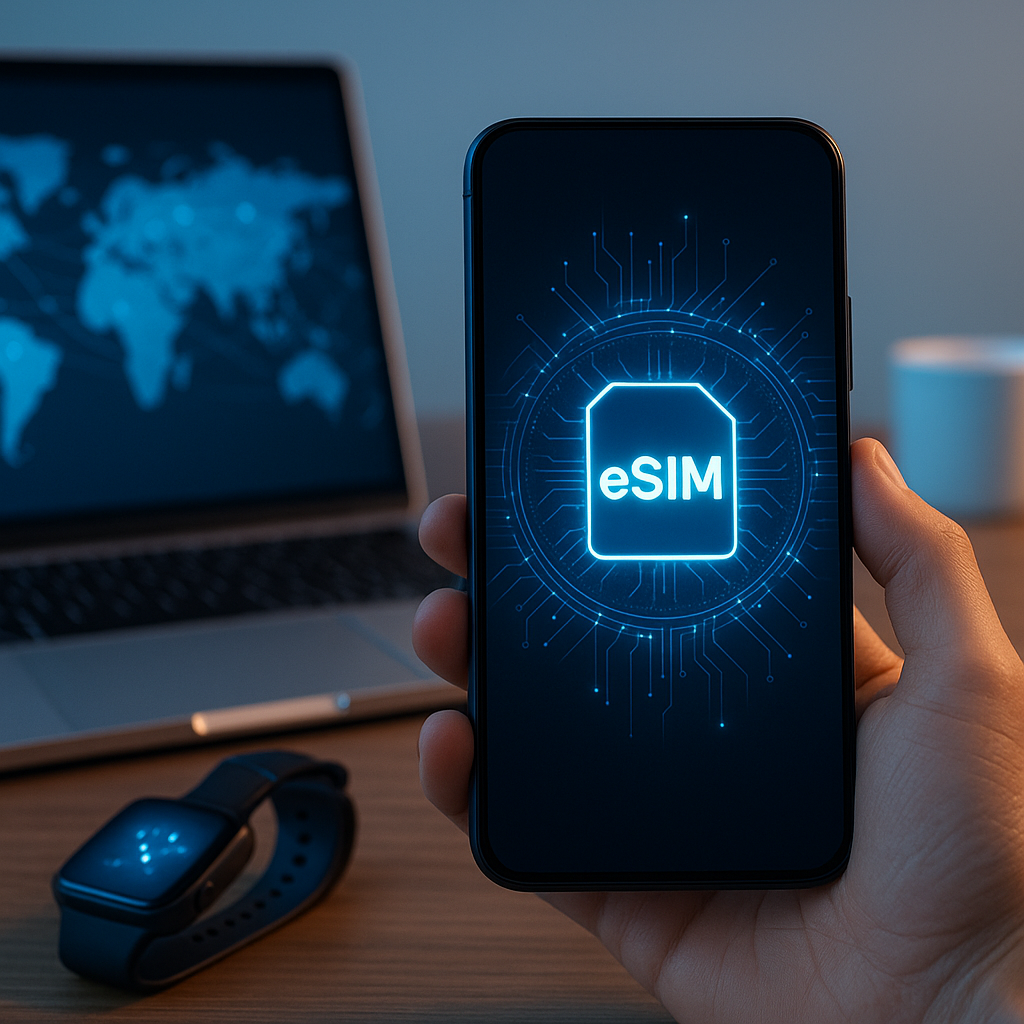
You know the feeling: the plane’s tires hiss down, the cabin lights ping, and your phone wakes up in a brand-new country already online, no plastic tray tool in sight. Seasoned digital nomads have been bragging about that moment for years, but in 2025 it’s no longer a niche travel trick. The same technology that lets backpackers beam TikToks from a tuk-tuk is creeping into every layer of connected life, from smartwatches to logistics pallets.
From Backpacker Hack to Backbone Tech
Back in 2018, eSIMs were synonymous with gap-year students dodging $10-a-day roaming fees. Fast-forward to today and Apple has dropped the physical SIM slot on all U.S. iPhones, while Google, Samsung, and Lenovo ship laptops that juggle half a dozen operator profiles at once. What changed?
- Carrier buy-in: AT&T, T-Mobile, and Verizon finally streamlined their “bring-your-own-eSIM” portals after seeing churn spike when unlocked phones made hopping networks painless.
- GSMA standards’ maturity: eUICC 2.3 and Remote SIM Provisioning (RSP) Phase 3 ironed out the quirks that used to brick early Pixels.
- IoT explosion: Smart meters, cargo trackers, even telehealth wearables needed a SIM they could’t swallow or snap and eSIM fit the bill.
Think of it like the leap from paper airline tickets to app-based boarding passes: once infrastructure caught up, the cardboard stub felt prehistoric overnight.
Under the Hood: Remote SIM Provisioning in Plain English
The Three-Server Dance
- SM-DP+ (Subscription Manager–Data Preparation Plus) hosts the encrypted operator profiles.
- SM-SR (Subscription Manager–Secure Routing) brokers the handshake between your gadget and the carrier.
- LPA (Local Profile Assistant) lives on the device, requesting, downloading, and activating the profile.
When you scan a QR code, the LPA sends a one-time token to the SM-DP+, which spits back a 300-KB profile housing IMSI credentials and network keys. The whole flow rides end-to-end TLS, then parks the profile inside the phone’s tamper-resistant eUICC chip an enclave separate from Android or iOS itself.
Security & Privacy Upgrades
- SIM-swap resistance: Because provisioning tokens expire instantly, phishing a QR image after the fact is worthless.
- Remote kill-switch: Lose a device in Vegas? Disabling the profile from your carrier dashboard cuts data access without waiting for a new plastic card.
- Dual-stack freedom: Spin up a local line for rideshare apps while your primary U.S. number keeps 2FA texts flowing.
The takeaway: eSIM isn’t just smaller; it’s fundamentally harder to spoof.
Hands-On: Live in 90 Seconds No Tiny Paperclip Required
On a Pixel 8 Pro we grabbed an unlimited-data travel plan from Holafly’esim. Here’s the stopwatch-verified setup:
| Step | Action | Time |
| 1 | Purchase plan on laptop, QR arrives by email | 0:00 |
| 2 | Pixel → Settings → Network → “Add eSIM” | 0:20 |
| 3 | Scan QR, label profile “UK-Data” | 0:45 |
| 4 | Toggle UK-Data as primary for mobile data | 1:05 |
| 5 | Enable Data Roaming for that line | 1:15 |
| 6 | Signal bars appear (tested on Vodafone London) | 1:30 |
Mission accomplished: coffee still warm, boarding group not yet called. The same workflow applies to smartwatches, LTE tablets, and Windows-on-Arm laptops.
Devices Going eSIM-Only: Who’s First, Who’s Next?
| Category | Flagship Example | eSIM Upside | Timeline to Plastic-Free |
| Smartphones | iPhone 15 US | Space for larger battery & haptics | Already here |
| Smartwatches | Galaxy Watch 7 LTE | Waterproofing, size | 2024-present |
| Laptops | Lenovo ThinkPad X1 Nano Gen 4 | Hot-swap carrier profiles for road warriors | 2025 models |
| Automotive | GM Ultium connected cars | OTA carrier switch, lower recall risk | 2026 fleet |
| Massive IoT | DHL smart pallets | No SIM tray, automated provisioning at scale | Rolling out now |
Carrier Economics & FCC Waves About to Break
U.S. carriers long feared eSIM would turn number portability into a turbocharged game of musical chairs until they spotted the churn data: users actually spent 11 % more on data when onboarding friction disappeared. The FCC’s pending “Unlocking 2.0” docket may soon require multi-profile support out of the box, further eroding the old lock-in model.
Simultaneously, MVNOs like Google Fi are weaponising eSIM to let subscribers flip from T-Mobile to UScellular towers in real time, maximising signal the way ride-hailing apps once gamified surge pricing. Expect 2026 to bring pay-per-gig marketplaces where profiles download as seamlessly as Spotify tracks.
Future-Proof Buyer’s Checklist
- Look for dual-eSIM, dual-active if you juggle work and travel numbers.
- Demand SM-DP+ 3.0 compliance for devices expected to last five years.
- Chase multi-profile capacity (≥10) IoT boards supporting 20+ profiles are already sampling.
- Verify hotspot policy; some unlimited plans throttle tethering after 5 GB.
- Keep a PDF of your QR codes in encrypted cloud storage for re-provisioning.
The Road Ahead: Satellite Profiles, Multi-IMSI & Beyond
The GSMA is testing eSIM for Satellite, letting low-Earth-orbit constellations slot in as just another profile. Meanwhile, carriers flirt with multi-IMSI pools that shapeshift numbers to dodge congestion imagine your phone transparently switching from AT&T to a Canadian affiliate during a Yellowstone hike without you lifting a finger.
Add in emerging secure elements baked directly into SoCs, and plastic SIMs look as dated as flip-phones.
Final Boarding Call
eSIM started as a nifty hack that let globe-trotters save beer money in Barcelona. Today it’s the connective tissue for everything from your MacBook to next-gen heart monitors. Whether you’re a CTO speccing an IoT rollout or a weekend warrior booking a layover in Lisbon, ditching the physical SIM slot is the fastest upgrade you can make this year.So before your next wheels-up, load an eSIM maybe even try the friction-free flow at Holafly’esim and stride past the plastic graveyard with a smug side-eye at the SIM-card vending machines. The future is embedded, encrypted, and refreshingly tray-tool-free.