
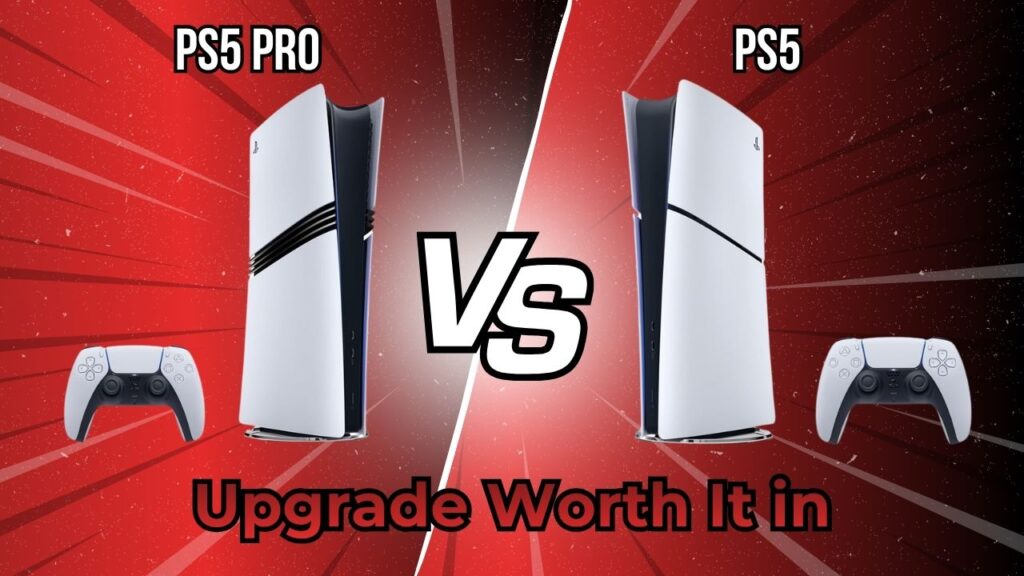
PS5 Pro vs PS5: Is the Upgrade Worth It in 2026?
As an Amazon Associate, we earn from qualifying purchases.
You might also want to read:
- Gaming Laptop vs PC: Which is Better in 2026?
- Best Gaming Setup Under $500 Complete Budget Build Guide 2026
- Best GPU for 1080p Gaming (Budget Builds 2026)
The PlayStation 5 Pro arrived in November 2024 with promises of better graphics, smoother frame rates, and a more powerful GPU. Now, in mid-2026, with over a year of real-world performance data and a Sony-mandated price increase already behind us it is the right time to give you an honest, numbers-backed answer to the question every PlayStation buyer in the USA is asking.
Is the PS5 Pro worth $899? Is the standard PS5 still a smart buy at $649? And does the PS5 Digital Edition at $599 make sense for most American gamers?
The PS5 Pro vs PS5 debate is the single most common question facing PlayStation buyers in 2026, and the honest answer is more nuanced than the marketing suggests.
I am going to give you that honest answer covering every meaningful difference between the two consoles, what the performance gap actually means in real games, and exactly who should buy each one.
PS5 Pro vs PS5 Quick Answer
Buy the PS5 Pro if: You own a 4K/120Hz TV, play PS5 Pro Enhanced games regularly, and want the sharpest possible image quality with stable frame rates. Budget is not your primary concern.
Buy the standard PS5 if: You game on a 1080p TV, play casually, or want the best price-to-performance ratio. The game library is identical on both consoles.
Buy the PS5 Digital Edition if: You want the lowest entry price and are comfortable buying all games digitally. Same CPU and library as the disc PS5, just cheaper.
The Core Difference What Actually Changed
Sony’s mid-generation refresh pairs a 60-compute-unit GPU rated at roughly 16.7 TFLOPS against the standard PS5’s 36-CU, 10.28 TFLOPS design a raster jump Sony pegs at around 45% faster, with ray tracing performance up to 2–3× faster.
Everything that matters differently between PS5 Pro and PS5 flows from one component: the GPU. Everything else the CPU, the game library, the DualSense controller, the SSD speed is either identical or very close. Understanding what the GPU upgrade actually delivers in real games is the key to making the right purchasing decision.
Complete Specs Comparison PS5 Pro vs PS5
| Spec | PS5 Pro | PS5 (Standard) | PS5 Digital |
| GPU | 60 CUs ~16.7 TFLOPS | 36 CUs 10.28 TFLOPS | 36 CUs 10.28 TFLOPS |
| GPU Architecture | AMD RDNA 3 | AMD RDNA 2 | AMD RDNA 2 |
| Rasterization | ~45% faster than PS5 | Baseline | Baseline |
| Ray Tracing | 2-3x faster than PS5 | Baseline | Baseline |
| CPU | ~10% faster | Baseline | Baseline |
| Memory Bandwidth | ~576 GB/s | 448 GB/s | 448 GB/s |
| Storage | 2TB SSD | 1TB SSD | 825GB SSD |
| AI Upscaling | PSSR (PlayStation Spectral Super Resolution) | None | None |
| Wi-Fi | Wi-Fi 7 | Wi-Fi 6 | Wi-Fi 6 |
| Disc Drive | Not included ($79.99 add-on) | Included | Not included |
| US Price (2026) | $899.99 | $649.99 | $599.99 |
GPU The Most Important Difference
The PS5 Pro uses an RDNA 3-based GPU architecture delivering approximately 16.7 TFLOPS of compute power versus the standard PS5’s 10.28 TFLOPS a 67% increase in raw GPU performance. AMD’s RDNA 3 architecture itself represents a significant leap over RDNA 2 in both rasterization performance and ray tracing throughput, so the Pro isn’t just running the same architecture faster it’s running a fundamentally more capable architecture.
This matters in practice. On the base PS5, many demanding games force players to choose between a 30fps Quality mode with full resolution and ray tracing, and a 60fps Performance mode that drops resolution and visual effects. The Pro’s extra GPU headroom frequently lets developers deliver something close to Quality-mode visuals at Performance-mode frame rates a single mode that no longer asks you to compromise.
That is the PS5 Pro’s core value proposition in one sentence. If you have been frustrated by the Quality vs Performance trade-off in games like Spider-Man 2, Demon’s Souls Remake, or Horizon Forbidden West the Pro is specifically built to solve that problem.
PSSR Sony’s Answer to DLSS
PlayStation Spectral Super Resolution (PSSR) is Sony’s answer to NVIDIA’s DLSS and AMD’s FSR. It uses machine learning to upscale lower-resolution images to near-native 4K quality.
PSSR is the PS5 Pro’s most significant exclusive software feature. The GPU renders at a lower internal resolution, then PSSR’s AI system reconstructs the image to near-4K quality delivering sharp, detailed visuals with less raw GPU demand than native 4K rendering.
The PS5 Pro pushes things further. There is better GPU power, AI upscaling, and stronger ray tracing. They all give you noticeable improvements in clarity and smoothness. It feels closer to high-end PC gaming in some scenarios.
The honest caveat is that PSSR only works in PS5 Pro Enhanced games titles that developers have specifically updated to support it. Games without a Pro Enhancement patch run exactly the same as on the standard PS5.
Ray Tracing A Real Upgrade
Ray tracing performance is up to 2–3× faster on the PS5 Pro. This is the area where the PS5 Pro delivers its most visually dramatic improvement over the standard console.
On the standard PS5, ray tracing is frequently disabled in Performance mode or runs at reduced quality in Quality mode. On the PS5 Pro, games can run ray tracing at higher quality settings while maintaining 60fps performance that the base PS5 could not sustain simultaneously.
For games with significant ray tracing implementation reflections, global illumination, accurate shadows the PS5 Pro’s advantage is immediately visible on a capable 4K display.
Real-World Performance What the Numbers Actually Mean
Tom’s Guide, in its 2026 PS5 vs PS5 Pro comparison, observed that the Pro delivers a noticeably sharper 4K image and “sometimes up to 20% more frames per second” in supported titles.
The PS5 Pro GPU is 67% more powerful than the standard PS5. In real-world gaming, expect 30-50% better performance in enhanced titles.
These numbers are real but they come with an important condition. The performance improvements are concentrated in PS5 Pro Enhanced games on 4K displays. For games without Pro Enhancement patches, the two consoles perform identically. For players on 1080p TVs, the visual improvements are minimal because the display cannot resolve the difference between PSSR-upscaled 4K and standard PS5 output.
Storage PS5 Pro Doubles the Space
The PS5 Pro ships with 2TB of internal SSD storage compared to 1TB on the standard PS5. In 2026, where many PS5 games exceed 80-100GB in size, this is a genuinely meaningful difference for players who keep large libraries installed simultaneously.
The standard PS5’s 1TB fills up quickly Call of Duty alone can exceed 200GB. The PS5 Pro’s 2TB gives players meaningfully more headroom before needing to manage storage or purchase an expansion SSD.
Wi-Fi 7 vs Wi-Fi 6 Small Real-World Impact
The PS5 Pro adds Wi-Fi 7 support versus Wi-Fi 6 on the standard PS5. In practice, this only benefits players with Wi-Fi 7 routers it reduces latency and increases wireless throughput for online gaming and large downloads. For most players using standard routers, there’s no functional difference.
Wi-Fi 7 routers are still not common in most American homes in 2026. For the majority of US buyers, this specification difference has no practical impact on their daily gaming experience.
Design and Cooling
At first glance, both consoles follow the same futuristic aesthetic. The PlayStation 5 Pro is bulkier than the slimmed-down PS5 models, mainly due to its upgraded cooling system. Sony redesigned the cooling with advanced liquid-metal heat distribution and redesigned fan blades to manage the higher heat output of the more powerful GPU.
Fan noise during gameplay remains within 38–42 dB comparable to the PS5 Slim and not meaningfully louder despite the extra performance headroom.
The PS5 Pro is physically larger than the PS5 Slim but runs comparably quiet. Both consoles work with all official PS5 DualSense controllers. Whether you stick with the PS5 or upgrade to the Pro, haptic feedback and adaptive triggers remain some of the most immersive controller features in gaming today.
Price The Biggest Barrier
As of the April 2, 2026 price change, the PS5 Pro has a US recommended retail price of $899.99. The standard disc PS5 is $649.99 and the PS5 Digital Edition is $599.99. The Pro does not include a disc drive, which is an additional $79.99 if you want one.
This means a fully disc-equipped PS5 Pro costs $979.98 a $330 premium over the standard disc PS5 at $649.99.
That $330 gap is the central question of this comparison. The performance improvements are real. The question is whether they are worth $330 to your specific gaming situation.
Complete Head-to-Head Every Factor Compared
1. GPU Performance
PS5 Pro: Up to ~45% faster GPU rendering, AI upscaling (PSSR), enhanced frame stability and ray tracing. PS5: Excellent price-to-performance ratio, full library of current AAAs and exclusives.
Winner: PS5 Pro significantly more raw GPU power.
2. Game Library
Both consoles play every PS5 game. The game library is completely identical every title available on PS5 is available on PS5 Pro. The only difference is that PS5 Pro Enhanced games run at better settings on the Pro.
Winner: Draw identical library on both consoles.
3. Value for Money
It is worth it for players with a 4K/120Hz display and a library of PS5 Pro Enhanced games, where the sharper image and steadier frame rates are clearly visible. For 1080p users, casual players, or anyone focused on value, the standard PS5 is the better buy because the CPU and game library are identical.
Winner: PS5 (Standard) better value for most players.
4. Future-Proofing
The PS5 Pro’s larger 2TB SSD, faster GPU, and Wi-Fi 7 provide more headroom as games continue to grow in size and complexity over the next several years.
Winner: PS5 Pro built for the next 3-4 years of gaming growth.
5. Ray Tracing Quality
Ray tracing performance is up to 2–3× faster on the PS5 Pro. Games that struggle to run ray tracing at 60fps on PS5 can do so comfortably on the Pro.
Winner: PS5 Pro dramatically better ray tracing at playable frame rates.
6. Storage
2TB vs 1TB. In an era of 100GB+ game installs, the extra space is a daily quality-of-life improvement.
Winner: PS5 Pro double the storage from day one.
7. Price
The price gap between a disc-equipped PS5 and PS5 Pro is now over $300.
Winner: PS5 (Standard) $300 less for identical gaming library.
8. Display Compatibility
The PS5 Pro’s advantages are primarily visible on 4K displays, and fully realized on 4K/120Hz panels. On 1080p TVs, the two consoles look nearly identical in most games.
Winner: Depends on your TV 4K owners benefit most from the Pro.
Head-to-Head Summary
| Category | PS5 Pro | PS5 Standard | Winner |
| GPU Performance | 16.7 TFLOPS | 10.28 TFLOPS | PS5 Pro |
| AI Upscaling | PSSR included | None | PS5 Pro |
| Ray Tracing | 2-3x faster | Baseline | PS5 Pro |
| Storage | 2TB | 1TB | PS5 Pro |
| Wi-Fi | Wi-Fi 7 | Wi-Fi 6 | PS5 Pro |
| Game Library | Identical | Identical | Draw |
| Disc Drive | Add-on ($79.99) | Included | PS5 Standard |
| Price | $899.99 | $649.99 | PS5 Standard |
| Value for Money | Lower | Higher | PS5 Standard |
Who Should Buy the PS5 Pro?
Buy the PS5 Pro if ALL of the following apply to you:
You own a 4K TV ideally 4K/120Hz with HDMI 2.1 You play PS5 Pro Enhanced games (Spider-Man, God of War, Horizon, etc.) The Quality vs Performance mode trade-off has genuinely bothered you You want the best possible PlayStation gaming experience without compromise $899 is within your budget
Who Should Buy the Standard PS5?
Buy the standard PS5 if ANY of the following apply to you:
You game on a 1080p TV You play casually a few hours per week You primarily play multiplayer games like Call of Duty or Fortnite You want the best price-to-performance ratio on PlayStation Budget is a meaningful consideration
PlayStation 5 Pro Console 2TB Best for Serious PS5 Gamers

4.7 ★★★★★ 4.7 out of 5 stars (536)
Key Specs:
GPU: 60 Compute Units ~16.7 TFLOPS (RDNA 3)
Rasterization: 45% faster than PS5
Ray Tracing: 2-3x faster than PS5
Storage: 2TB Ultra-High Speed NVMe SSD
Memory Bandwidth: 576 GB/s
Disc Drive: Not included $79.99 add-on separately
CPU: AMD Zen 2 (~10% faster than PS5)
The PS5 Pro is the most powerful PlayStation console ever made and in 2026, it is the right choice for a specific type of gamer. The PS5 Pro delivers up to ~45% faster GPU rendering, AI upscaling with PSSR for better visuals, a larger 2TB SSD, Wi-Fi 7 support, and enhanced frame stability and ray tracing.
The 2TB internal SSD is the most immediately practical upgrade over the standard PS5 for most buyers doubling the space for game installs and eliminating the frustrating storage management that 1TB forces. Games like Call of Duty, God of War Ragnarök, and Horizon Forbidden West all exceed 80-100GB individually, and the library of large-file games only grows.
PSSR is the technology that makes the PS5 Pro feel genuinely next-generation in supported titles. Much like NVIDIA’s DLSS, PSSR uses an AI-driven temporal upscaling method bridging the gap between fixed-function consoles and flexible PC AI clusters. The result is near-4K image quality with the GPU demand of a lower internal resolution sharp visuals at frame rates the standard PS5 cannot maintain.
The PS5 Pro made up 13% of all PS5 consoles sold in the US during 2025 meaningful market uptake for a $250 price premium over the launch-era standard console.
Key Specs:
- GPU: 60 Compute Units ~16.7 TFLOPS (RDNA 3)
- Rasterization: ~45% faster than PS5
- Ray Tracing: 2-3x faster than PS5
- AI Upscaling: PSSR PlayStation Spectral Super Resolution
- Storage: 2TB Ultra-High Speed NVMe SSD
- Memory Bandwidth: ~576 GB/s
- Wi-Fi: Wi-Fi 7
- Disc Drive: Not included $79.99 add-on separately
- CPU: AMD Zen 2 (~10% faster than PS5)
Pros:
- 45% faster GPU rasterization visibly better in Pro Enhanced games
- PSSR AI upscaling near-4K quality from lower render resolution
- 2TB SSD double the storage from day one
- 2-3x faster ray tracing dramatically better reflections and lighting
- Wi-Fi 7 ready for next-gen home networks
- Best PlayStation gaming experience available in 2026
- Compatible with all PS5 games and DualSense controllers
Cons:
- $899 most expensive PlayStation console ever
- No disc drive included add $79.99 for physical game support
- PSSR improvements only visible in Pro Enhanced titles
- Advantages minimal on 1080p TVs
- $330 premium over standard PS5 for same game library
Who Should Buy It? It is worth it for players with a 4K/120Hz display and a library of PS5 Pro Enhanced games, where the sharper image and steadier frame rates are clearly visible. If you have a capable 4K TV, play story-driven or graphically demanding PS5 games, and have been frustrated by the Quality vs Performance trade-off the PS5 Pro eliminates that compromise.
PlayStation 5 Digital Edition Best Value PS5 in 2026

4.8 ★★★★★ 4.8 out of 5 stars (610)
Key Specs:
GPU: 36 Compute Units 10.28 TFLOPS (RDNA 2)
Memory Bandwidth: 448 GB/s
Wi-Fi: Wi-Fi 6
CPU: AMD Zen 2 8 cores at 3.5GHz
Ray Tracing: Hardware accelerated
4K: Up to 4K/120fps output
Price: $599.99
For 1080p users, casual players, or anyone focused on value, the standard PS5 is the better buy because the CPU and game library are identical.
The PS5 Digital Edition is the same PS5 you know same AMD RDNA 2 GPU at 10.28 TFLOPS, same Zen 2 CPU, same ultra-fast SSD, same DualSense haptic feedback and adaptive triggers, same complete library of every PS5 game at the lowest possible entry price. The only difference from the disc model is the absence of a physical disc drive, which reduces the price and removes the option to play physical game discs.
For the majority of American PS5 buyers in 2026 who buy most games digitally through the PlayStation Store anyway the Digital Edition represents the most practical PlayStation purchase. The game library is 100% identical to every other PS5 model. No game is better or worse on the Digital Edition compared to the disc PS5.
The 825GB SSD fills up faster than the standard 1TB model storage management becomes a regular chore with large game installs. An M.2 SSD expansion (sold separately) solves this permanently for around $60-80.
Both consoles work seamlessly with official PS5 DualSense controllers. Whether you stick with the PS5 or upgrade to the Pro, haptic feedback and adaptive triggers remain some of the most immersive controller features in gaming today.
Key Specs:
- GPU: 36 Compute Units 10.28 TFLOPS (RDNA 2)
- Storage: 825GB Ultra-High Speed NVMe SSD
- Memory Bandwidth: 448 GB/s
- Wi-Fi: Wi-Fi 6
- Disc Drive: None digital games only
- CPU: AMD Zen 2 8 cores at 3.5GHz
- Ray Tracing: Hardware accelerated
- VRR: Variable Rate Refresh reduces screen tearing
- 4K: Up to 4K/120fps output
Pros:
- Most affordable PS5 available $599
- Identical game library to every other PS5 model
- Full PS5 performance same GPU and CPU as disc model
- DualSense haptic feedback and adaptive triggers included
- 4K/120fps output support with VRR
- Best price-to-performance ratio on PlayStation in 2026
- Complete backward compatibility with PS4 library
Cons:
- No disc drive physical game discs not compatible
- 825GB storage fills up quickly with modern game sizes
- No PSSR upscaling
- Less GPU power than PS5 Pro
- Wi-Fi 6 instead of Wi-Fi 7
Who Should Buy It? For 1080p users, casual players, or anyone focused on value, the standard PS5 is the better buy because the CPU and game library are identical. The PS5 Digital Edition is the right choice for the majority of American gamers the same PlayStation experience at the lowest possible price.
Does Your TV Matter? The Display Question
This is the most important factor that most PS5 Pro vs PS5 guides skip and it directly determines whether the PS5 Pro upgrade is worth anything to you personally.
If You Own a 4K/120Hz TV with HDMI 2.1:
The PS5 Pro is built for you. PSSR upscaling delivers near-native 4K image quality. The faster GPU maintains 60fps in games that drop to 30fps on the standard PS5. Ray tracing runs at settings the base console cannot sustain. You will see and feel the difference every time you play a Pro Enhanced game.
If You Own a 4K/60Hz TV:
The PS5 Pro still delivers visual improvements better image quality through PSSR and improved ray tracing. The 120fps advantage disappears, but sharper visuals at 60fps are still clearly visible. The upgrade is meaningful but not transformative.
If You Own a 1080p TV:
For 1080p users, the standard PS5 is the better buy because the CPU and game library are identical. The PS5 Pro’s primary advantages PSSR upscaling to near-4K and higher resolution output simply cannot be displayed on a 1080p screen. You would be paying $300 extra for improvements your TV cannot show you.
PS5 Pro vs PS5 Sales Data What American Gamers Are Actually Buying
The PS5 Pro made up 13% of all PS5 consoles sold in the US during 2025. As of July 2025 it held a sub-5% share of lifetime US PS5 sales against a base-PS5 US total of 26.45 million units.
These numbers tell a clear story. The vast majority of American PS5 buyers over 95% chose the standard PS5 over the Pro. The standard PS5 at its lower price point with its identical game library is the right choice for most American households. The PS5 Pro is a deliberate premium choice for a specific type of player.
FAQ PS5 Pro vs PS5
Q: What is the difference between PS5 Pro and PS5? The core PS5 Pro vs PS5 specs differences are the GPU (60 compute units and ~16.7 TFLOPS vs 36 CUs and 10.28 TFLOPS), memory bandwidth (~576 GB/s vs 448 GB/s), storage (2TB vs 1TB), Wi-Fi (7 vs 6), and the Pro-exclusive PSSR upscaling and stronger ray tracing. The CPU, game library, DualSense controller, and SSD speed are essentially identical.
Q: Is the PS5 Pro worth it? It is worth it for players with a 4K/120Hz display and a library of PS5 Pro Enhanced games, where the sharper image and steadier frame rates are clearly visible. For 1080p users, casual players, or anyone focused on value, the standard PS5 is the better buy because the CPU and game library are identical.
Q: How much faster is the PS5 Pro GPU vs PS5? The PS5 Pro GPU is 67% more powerful than the standard PS5 in raw compute units. Sony officially states approximately 45% faster rasterization in typical game workloads. Ray tracing is 2-3x faster. In real-world gaming, expect 30-50% better performance in Pro Enhanced titles.
Q: Does PS5 Pro include a disc drive? No. The Pro does not include a disc drive, which is an additional $79.99 if you want one. This means a fully disc-equipped PS5 Pro costs approximately $979.98 over $330 more than the standard disc PS5.
Q: What is PSSR on PS5 Pro? PlayStation Spectral Super Resolution (PSSR) is Sony’s answer to NVIDIA’s DLSS and AMD’s FSR. It uses machine learning to upscale lower-resolution images to near-native 4K quality. PSSR only works in PS5 Pro Enhanced games titles that developers have specifically updated to support it.
Q: Can PS5 Pro play all PS5 games? Yes every PS5 game works on PS5 Pro. The game library is 100% identical between both consoles. PS5 Pro Enhanced games simply run at better settings on the Pro. Games without a Pro Enhancement patch run exactly the same on both consoles.
Q: Should I upgrade from PS5 to PS5 Pro? Only if you have a 4K display and regularly play games that have received PS5 Pro Enhancement patches. For players who already own a PS5 and game on a 1080p display or play primarily online multiplayer titles the upgrade delivers minimal visible benefit for a $250-$330 price difference.
Q: What is the PS5 Pro price in the USA in 2026? As of the April 2, 2026 price change, the PS5 Pro has a US recommended retail price of $899.99. The standard disc PS5 is $649.99 and the PS5 Digital Edition is $599.99.
Final Verdict PS5 Pro vs PS5 2026
| Console | US Price | Best For |
| PS5 Pro (2TB) | $899.99 | 4K/120Hz TV owners, serious PS5 gamers |
| PS5 Standard (Disc) | $649.99 | Most US gamers best value |
| PS5 Digital Edition | $599.99 | Budget buyers who game digitally |
The honest answer is more nuanced than the marketing suggests. Whether the PS5 Pro translates into a visible upgrade depends entirely on which games you play and which display you own.
For most American PlayStation buyers in 2026 the standard PS5 Digital Edition at $599 or the disc model at $649 is the right choice. The game library is identical. The performance is excellent. And the $300 saved goes a long way toward games, accessories, or a better TV that would benefit both consoles equally.
For 4K TV owners who play graphically demanding PS5 games and have been genuinely frustrated by choosing between Quality and Performance modes the PS5 Pro solves that problem in a way that is immediately visible every time you play a Pro Enhanced title. The $899 price is steep. The performance upgrade is real.
The right PlayStation is the one that matches your display, your gaming habits, and your budget. Both consoles play the same games. Only one of them will look meaningfully different in your specific living room setup.
As an Amazon Associate, Eerone earns from qualifying purchases. Product prices shown are in USD and approximate. Always check Amazon.com for the latest US price, availability, and shipping options.